

I was a lender for five years. So I spent a lot of time talking about debt consolidation like it was a singular financial solution. A borrower takes out a personal loan to pay off multiple debts and ends up with one tidy monthly payment.
But after interviewing five people who had no choice but to research debt consolidation options, I realized my definition was not entirely accurate.
In reality, “debt consolidation” can mean a personal loan, line of credit, balance transfer card, or even a home equity line of credit (HELOC), which is secured with the equity in your home. Really, any maneuver that uses new credit to pay off multiple existing debts.
Here’s how five Canadians consolidated their debt, the products they used, what their lenders required, and where they are now.
Improve your credit score with a Neo Secured Mastercard! Plus, sign up now via the button below and get a $60 welcome bonus.*
Limited-time offer. Only valid for new Neo customers who open their first eligible Neo credit product and make a purchase within 90 days.
Mike From Mississauga, Ontario: Consolidated $40K Debt With a Bank Loan
“I got divorced and was left with all the marriage debt,” says Mike. He was 33 when life threw him a financial curveball. It left him with about $37,000 in credit card debt at 19.99%, and $12,000 on a line of credit at 12% plus prime.
He was paying approximately $1,258 a month in combined minimum monthly payments. “I realized I was spending too much on interest and thought there must be a better way,” he explained.
At first, Mike thought he needed a consumer proposal. But after meeting with a Licensed Insolvency Trustee (LIT), he was advised against it because he had not missed any payments.
So he turned to his bank.
CIBC approved him for a $42,500 personal loan on a 5-year term at 7% plus prime. Prime is the base interest rate banks use to price loans and lines of credit, and it can move up or down when the Bank of Canada changes rates.
He used the CIBC loan to pay off his two credit cards and most of his line of credit. Now, instead of paying $1,258 in monthly payments across three credit products, he only had to make one payment of $750 per month. The consolidation loan dropped his monthly payment obligation by 40%.
The bank paid his creditors directly, and they required him to close both his Canadian Tire Mastercard and his line of credit. He was allowed to keep his CIBC credit card, but they lowered the limit to $3,000.
After two and a half years, Mike had paid the balance down from $42,500 to $12,000. Then he moved the remaining balance to a lower-interest line of credit and paid that off within 18 months.
Today, his credit score is 840. He still uses credit cards, but pays them off in full every month. “Being in debt, even a bit, gives me PTSD,” he told me. “I don’t like it.”
Amanda From Calgary, Alberta: Consolidated $10K With Balance Transfer Cards
“It began after making a couple large purchases in my early twenties and not being able to pay off my credit card fully.” And just like that, Amanda owed $41,000 across her car loan, credit cards, and line of credit. “The interest snowballed and put me in a position where it was no longer manageable,” she said.
Amanda tried calling the Credit Counselling Society for help. But since she had never missed a payment, the advisor said she was better off not consolidating through a debt management program (DMP). “I had a really good credit score. I didn’t want to risk that being impacted, even if temporarily,” she explained.
So she used 0% balance transfer cards strategically.
First, Amanda opened an MBNA True Line Mastercard. It had no annual fee, offered 0% interest for 12 months, charged a 3% transfer fee, and would revert to a 12.99% interest rate after the promo ended.
Then she opened a Scotiabank Value Visa. The annual fee was waived for the first year, then charged $29 per year after that. It offered 0% interest for 10 months, charged a 2% transfer fee, and would revert to a 13.99% interest rate after the promo.
Amanda moved $5,000 of her credit card debt to the MBNA card. When that promo ended, she moved the remaining balance to the Scotia card along with some debt from her line of credit to reach Scotia’s $5,000 card limit.
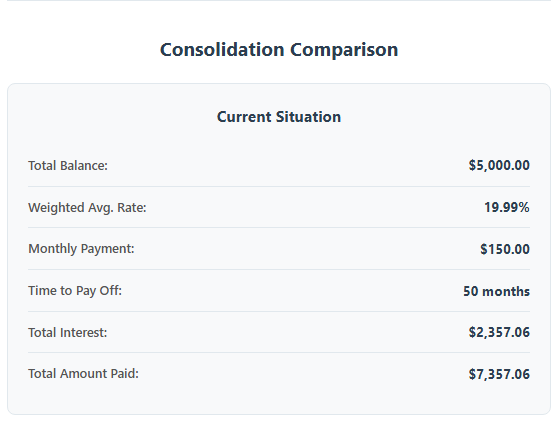
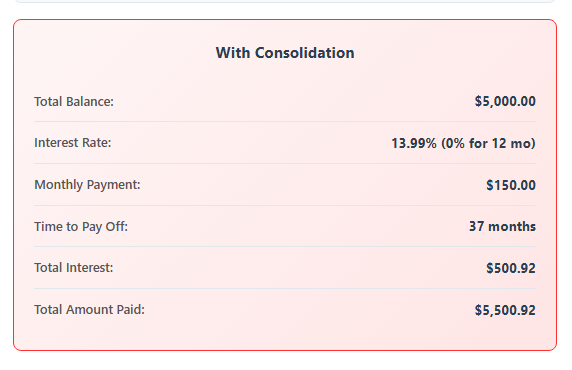
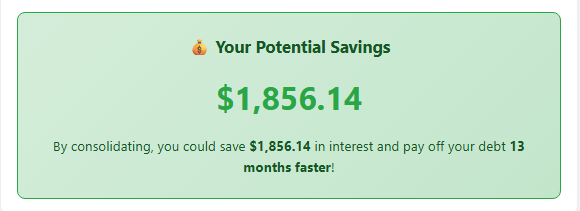
Of course, this didn’t consolidate all of her debt. But it did move chunks of her most expensive debt to 0% cards, so her payment would actually go to the principal instead of interest. “It definitely helped take a couple hundred dollars of interest off each month, which I was then able to apply directly towards my debt,” she said.
Her credit score dipped about 15 points briefly after applying for two new cards, but has since recovered to 828. So far, Amanda has paid off $10,000 of her debt, including the MBNA card and her car loan. She says her Scotiabank card will be paid off soon, and plans to pay off the remaining $27,000 of her debt within four years.
Jane From Vancouver, BC: Consolidated $15K With a Line of Credit
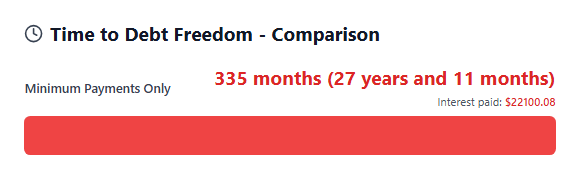
“I was in school and got married. Debt started accumulating because I was working less and spending more.” Jane owed $20,000 across four credit cards when she started looking for consolidation options. All her cards were charging 18.99% interest, and she was paying roughly $600 in total minimum monthly payments.
But then, she got lucky.
TD offered her a pre-approved unsecured line of credit for $15,000 at 6.98% plus prime. At the time, TD’s prime rate was 3.95%, bringing her total rate to 10.93%. That was nearly half the rate on her credit cards.
She used the line of credit to pay off most of her credit card debt, though it didn’t cover the full amount she owed.
The payment was about $150 per month. The minimum payment on her remaining credit card debt also dropped to about $150. So instead of paying roughly $600 per month across four cards, Jane’s total minimum monthly debt payments fell to about $300.
Even a partial consolidation helped cut her debt payments in half.
Because the line of credit was preapproved, TD did not require her to close any credit cards. That’s pretty risky, given she could max them out again. But Jane says she avoided the debt trap by never carrying a balance on her cards.
She paid off $15,000 in under a year. “I paid as much as I could towards the debt to ensure that more principal was being paid off every pay period,” she explained.
Today, she is debt-free, and her credit score has improved, including a 35-point increase in the last two years. “I am now able to save money, travel and buy things without feeling guilty,” she told me. “My mental health has improved.”
Pat From Ottawa, Ontario: From Consolidation Loan to Consumer Proposal
“It felt insurmountable,” he said. “It was a lot of stress.” Pat’s story started with a consolidation loan in 2015. He had gone back to university and was carrying credit card debt from school, the cost of living, and consumer spending.
He owed a total of $16,000 across two credit cards, with a $12,500 balance owing on his BMO Mastercard alone. “I probably paid back $25,000 on that BMO Mastercard, and it was still at $12,000,” said Pat.
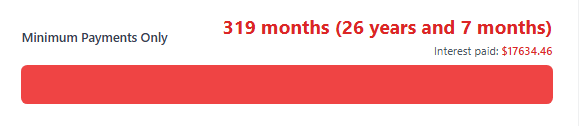
TD Bank gave him a $16,000 consolidation loan at 8% interest and a monthly payment of $350.
The bank paid off his credit cards directly and required him to close the BMO Mastercard. But the loan did not fix the root problem. He was not earning enough to keep up with all his financial obligations.
Within two years, he had gotten married, had a baby, and gotten divorced. Now he was trying to manage rent, legal fees, child-related expenses, his existing debt payments, and a higher cost of living.
He fell back on his credit cards to make ends meet.
By 2019, he still owed $14,000 on the original TD consolidation loan. He also had new balances on a TD Visa, a Capital One card, and a President’s Choice Mastercard. Altogether, he owed $20,000 in consumer debt and $19,500 in student loans on top of his TD consolidation loan.
“I was in overdraft all the time,” he explained. “My paycheques were already minus $500 right off the bat.” So in 2020, Pat entered a consumer proposal through MNP. It covered about $18,000 of the debt, with payments of $150 bi-weekly on a 5-year term at 0% interest. His student loans were not included.
He completed the proposal four months early. His credit score took a hit, but has since recovered to 700.
Today, Pat is debt-free and never carries a balance on his credit cards. He prioritizes saving and investing. “It changed my life. I can’t tell you how good it feels,” he told me. “I have zero regrets.”
Andrea From Ottawa, Ontario: Used a Debt Management Program After RBC Proved Unhelpful
“It got really bad when I was in college,” explained Andrea. “I got to a point where I was maxed out.” Her debt snowballed while she was in nursing school. Andrea couldn’t work full-time and comply with the placement requirements of her program. So she funded her social life with credit.
Then came the divorce.
Andrea now had to pay rent, bills, and everyday expenses on her own. She had about $21,000 of debt across her Capital One, RBC, and TD credit cards, as well as a line of credit. Her debt was costing her about $475 a month in combined minimum payments.
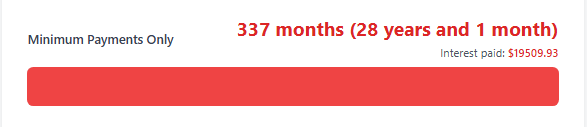
“I was paying more than the minimum, but I still wasn’t getting anywhere,” says Andrea. So she opened a line of credit and used it to consolidate the cards, but ultimately ended up using them again.
That’s when she reached out to the Credit Counselling Society for help. The counsellor recommended getting a consolidation loan from RBC. Because she had banked there since childhood, staying with her home bank would protect her credit. But RBC only offered a partial solution. They would not include her TD credit card, which had the biggest balance.
So back to the Credit Counselling Society she went. Through the Debt Management Program (DMP), her credit cards and line of credit were rolled into one payment of $448 per month, and the interest dropped to 0%. The agency took a small fee of about $20 per payment, and the rest went to her creditors.
The payment was tight, but Andrea said it was manageable because she had already been trying to pay around the same amount on her own. The difference now was that it was actually going to the principal instead of interest, and the DMP would be paid off in just four years.
Two years after finishing the program, Andrea remains debt-free and her credit score is 819. She uses her PC Mastercard for grocery points and pays it off immediately after use.
Looking back, she wishes she had asked for help sooner. “It was life-changing for me.”
Before You Consolidate…
Debt consolidation can be a lifeline when it lowers your interest rate, reduces your monthly payment, or makes your debt easier to manage. But it only works if you can afford the new payment and you don’t max out your cards again.
True debt consolidation, like a personal loan, line of credit, or balance transfer, usually has a limited impact on your credit score, aside from a hard credit check or closing credit cards.
Before you consolidate, ask yourself what happens the day after your credit cards are paid off. Without discipline and a realistic repayment plan, debt consolidation can lead to insolvency.


