

Every week, my family spends about $180 on groceries at our local supermarket. This budget helps to feed me, my husband, and our son. And if you know anything about growing boys, they’ll happily raid through your fridge with a never-ending appetite. Honestly, some weeks can be challenging to stick to our budget. This is especially true when the cost of basic groceries like dairy, poultry, and vegetables has gone up in recent years.

For a limited-time, get a $60 bonus* when you sign up for any Neo card.
From fast approval to everyday rewards, the Neo Mastercard pays you back. Literally. Plus, get instant access to your virtual card as soon as you're approved so you can start spending and earning right away.
* Limited-time offer. Only valid for new Neo customers who open their first eligible Neo credit product and make a purchase within 90 days. Limit of one offer per customer. Offer is subject to the Neo Rewards Policy and may be amended or cancelled at any time without notice.
So, it got me thinking: how can I reward myself for this recurring grocery bill, amongst many other household expenses? Well, I decided to compare the best cash back card for groceries.
First, I created a hypothetical budget for a family of four with a gross income of $150,000. Then I calculated the cashback amounts for the top three credit cards in Canada. What was the outcome? When I entered the data into my spreadsheet, here is the cashback amount a cardholder would earn in a year without any promotions or welcome offers:
- Neo World Elite Mastercard - Gas & Grocery - $1,570.18
- CIBC Dividend Visa Infinite - $1,382.74
- BMO CashBack World Elite Mastercard - $1,125.14
Curious to know how I got these results? Read on to learn how I determined these figures and how you can get rewarded for your household spending.
Sample monthly budget for a family of four
In this scenario, I chose a family of four who live in Ontario. For this comparison, I used a household gross income of $150,000. I chose this amount to meet the household income requirements for these credit cards.
To keep things simple, both adults earn $75,000 per year. The average tax rate of 17.69% equals about $13,267 in income tax per person. Multiplying by two working adults gives you $26,535 in household income tax. Therefore, the after-tax income comes to nearly $123,465 per year. That works out to be $10,288 per month in net income. I applied this fictitious budget to calculate each credit card’s annual rewards.
The following are the assumptions I made in the budget:
The selection criteria
There are numerous credit cards available on the market. Based on my research, I compared the Neo World Elite Mastercard against two of Canada’s most commonly used grocery cashback cards to evaluate which performs best for a typical family of four's budget.
In particular, I chose credit cards that offer cash back for household spending. Since the Neo World Elite Mastercard has an annual fee, I chose credit cards that also have one. You’ll also notice in the table below that the income and credit score requirements are relatively on par with each other.
If you’re interested in no-fee credit cards, be sure to check out this article that explores the top free credit cards in Canada:
Below is a comparison of the best cash back cards for groceries:
How I calculated the rewards
Here’s a summary of each credit card’s benefits and how I created the formulas. You can follow along with my methodology by reviewing my spreadsheet.
In my spreadsheet, I calculated how much each credit card would reward this family in cashback and any welcome offers. All of these cards offered the highest cashback amounts for groceries and higher-than-average cashback amounts for gas & EV charging and recurring bill payments.
I made a few assumptions when calculating the cashback amounts:
- BMO, CIBC, and Neo Financial have spending caps that I factored into my calculations of each category’s cashback amounts.
- Recurring bill payments include car payments, utilities, cell phone and internet service, and subscriptions. However, because there are spending limits on each card, cashback rates typically drop to 1%.
- I excluded any rebates on annual fees, as they're not considered true cashback.
There are two expense categories that don’t go towards the credit card purchases:
- Housing costs, such as mortgage payments, are not paid through their chequing account. So, they don’t make payments with their credit card.
- This family sets aside savings each month, which is put into their savings and investment accounts instead.
Neo World Elite Mastercard - Gas & Grocery
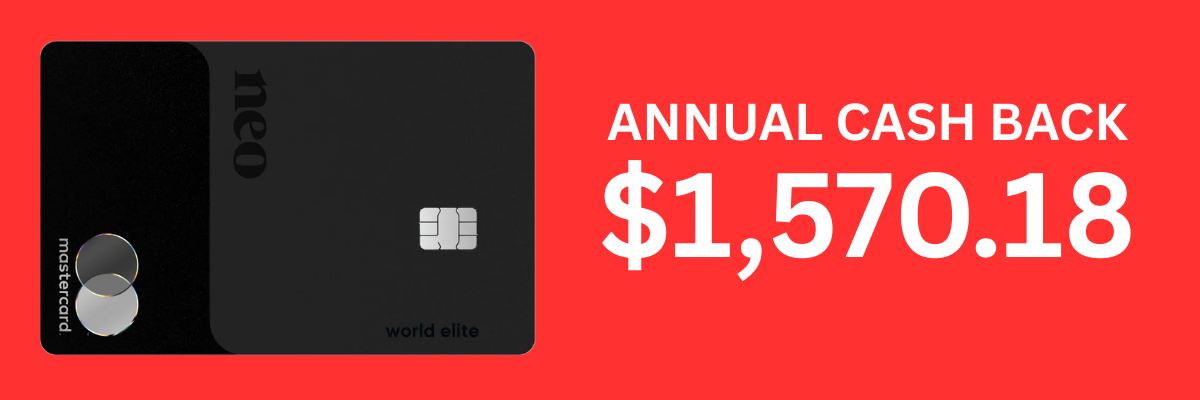
Welcome bonus offer: $60 sign-up bonus for MooseMoney readers signing up using this link.
Regular offer:
- 5% cashback on groceries, with a $1,000 monthly spending cap
- 4% on recurring payments, with a $500 monthly spending cap
- 3% on gas & EV charging, with a $1,000 monthly spending cap
- and 1% everything else
I also read through the terms and conditions with a fine-tooth comb. Neo advertises very high cashback rates as stated above. However, there are monthly spending caps which I’ve outlined for each category. Neo gives you high cashback rates every month, but only on a set amount of spending. Once you go over that amount, the additional spending earns 1% cashback. This means the credit card is the most rewarding for households that stay within those monthly limits.
CIBC Dividend Visa Infinite
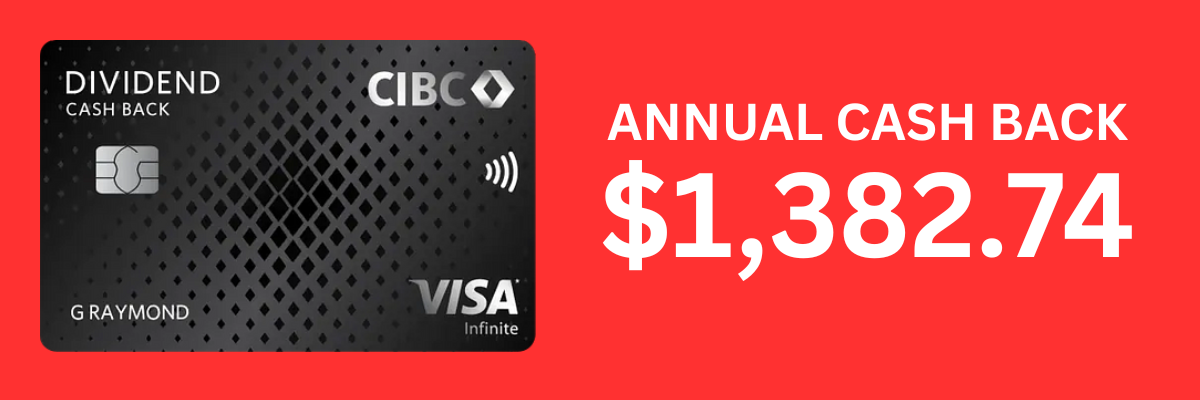
Welcome bonus offer:
- 10% cashback bonus on the first 4 statements. The maximum cashback is $200.
- $50 cashback for pre-authorized payment for the first 4 statements.
- A $120 rebate for the first-year annual fee. However, I did not include it in my cashback calculations.
Regular offer:
- 4% cashback on gas, EV charging, groceries
- 2% on transportation, dining, recurring payments, travel through CIBC by Expedia
- and 1% on everything else
CIBC says there’s no limit on cashback, but this only applies to the basic 1% rate. The higher cashback rates, such as 4% on groceries and 2% on bills, have annual spending limits. Basically, each year, CIBC lets you earn bonus cashback on:
- Up to $50,000 in total spending, and
- Up to $20,000 in certain everyday categories, such as groceries, gas, restaurants, and bills
After you reach those limits, the card still works, but the cashback rate drops to 1%. So, in my spreadsheet, I factored in the welcome offers along with the yearly spending caps.
BMO CashBack World Elite Mastercard
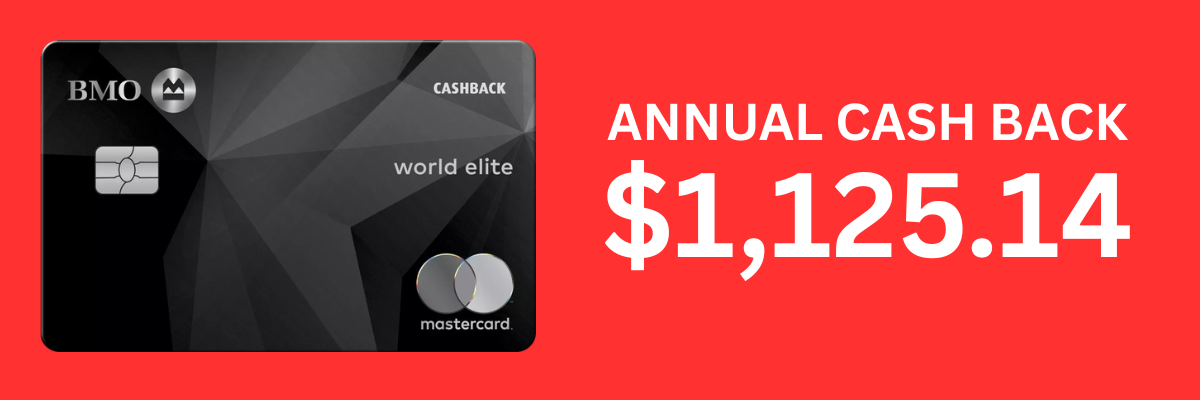
Welcome offer: $40 bonus cash back x 12 months = $480 (min spend of $2,000 each month). It also comes with a $139 annual fee waiver and $75 roadside assistance, but I didn’t factor those into the calculations.
Regular offer:
- 5% cashback on groceries, with a $500 monthly spending cap
- 4% on transit with a $300 monthly spending cap
- 3% on gas, with a $300 monthly spending cap
- 2% on recurring payments, with a $500 monthly spending cap
- 1% everything else.
I looked into the terms and conditions to really understand how their cashback system works. This card has spending limits on its bonus cashback rates. For example, you earn only 5% cashback on groceries, with a $500 spending limit. Once you spend beyond that amount, you earn 1% cashback.
How the cards stack up
All three credit cards offer strong cashback rates, but none of them has unlimited spending amounts. Neo and BMO have monthly spending limits based on different categories. CIBC has annual total spending limits. Understanding how these caps work is key to determining which card performs best for a specific household’s spending habits.
Based on the sample budget I created using after-tax dollars, groceries, gas, and bills account for a good chunk of household spending. These categories match Neo’s highest cashback offerings. When the spending caps and household spending behaviour were factored in, the Neo World Elite Mastercard delivered the highest blended annual value for a family of four.
BMO is a close competitor in many of the categories. Although Neo Financial edges out ahead with the groceries and gas rewards. CIBC looks appealing on paper. However, when applying the annual spending caps, the benefits are quickly reduced once you reach the maximum limit. As a result, Neo Financial outperforms traditional cashback cards despite having similar rates.
Remember, welcome offers are only available for a short time. When determining your reward potential, it’s ideal to calculate the rewards without any welcome offers. For instance, although the BMO CashBack World Elite Mastercard has a generous welcome offer that boosts the cashback to $1,605.14, keep in mind it applies only during the first year. After that, the cashback amount drops to $1,125.14, based on my sample model.
With regular cashback and no welcome offers, the difference between the highest and lowest amounts was $445.04 ($1,570.18 - $1,125.14 = $445.04). So, before you commit to a credit card, it’s worth the time and effort to run the numbers yourself to see how much you could potentially earn in rewards over the course of a year. To make it easy for you, check out our helpful credit card cashback calculator.
Finding a credit card that gives you the most rewards
As you can see, there isn’t a one-size-fits-all credit card that will suit all families. While all three credit cards offer high cashback rates, the real value depends on how quickly you reach their spending caps and where you concentrate your spending. Where you live, your lifestyle, and how many people live in your household will affect how much you spend each month. Ultimately, when you’re choosing the best card for groceries and gas, it should offer the highest rewards for the categories you spend the most on.


